
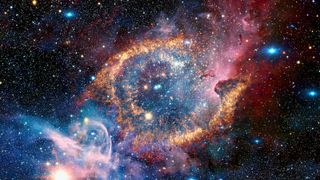
A personnel of astrophysicists has valid spawned 8 million weird and wonderful universes inner a supercomputer and allow them to evolve from valid toddlers to old geezers. Their function? To nail down the position that an invisible substance called darkish matter accomplished in our universe’s existence for the reason that Enormous Bang and what it methodology for our fate.
After discovering that our universe is mostly restful of darkish matter within the unhurried 1960s, scientists possess speculated on its position within the formation of galaxies and their ability to supply birth to recent stars over time.
In accordance to the Enormous Bang theory, no longer lengthy after the universe was as soon as born, an invisible and elusive substance physicists possess dubbed darkish matter began to clump collectively by the drive of gravity into big clouds called darkish matter haloes. Because the haloes grew in size, they attracted the sparse hydrogen fuel permeating the universe to approach motivate collectively and construct the stars and galaxies we note on the present time. In this theory, darkish matter acts as the backbone of galaxies, dictating how they construct, merge and evolve over time.
Linked: The 11 Superb Unanswered Questions About Dark Subject
To greater know the sort darkish matter fashioned this historical past of the universe, Peter Behroozi, an assistant professor of astronomy on the University of Arizona, and his personnel created his hang universes the employ of the faculty’s supercomputer. The computer’s 2,000 processors worked with out end over a span of three weeks to simulate bigger than 8 million weird and wonderful universes. Each and each universe individually obeyed a obvious design of rules to lend a hand researchers perceive the connection between darkish matter and the evolution of galaxies.
“On the computer, we can create many different universes and evaluate them to the real one, and that lets us infer which rules lead to the one we note,” Behroozi said in an announcement.
While earlier simulations possess pondering about modeling single galaxies or generating mock universes with restricted parameters, the UniverseMachine is the first of its scope. The program continuously created thousands and thousands of universes, each containing 12 million galaxies, and each allowed to conform over nearly the total historical past of the real universe from 400 million years after the Enormous Bang to the present day.
“The huge inquire of is, ‘How end galaxies construct?’” said glimpse researcher Risa Wechsler, a professor of physics and astrophysics at Stanford University. “The the truth is frosty facet about this glimpse is that we can employ all of the info now we possess about galaxy evolution — the numbers of galaxies, what number of stars they’ve and the design they construct those stars — and place that collectively into a comprehensive describe of the final 13 billion years of the universe.”
Linked: From the Enormous Bang to Level to: Snapshots of Our Universe Thru Time
Creating a reproduction of our universe, or even of a galaxy, would require an inexplicable amount of computing vitality. So Behroozi and his colleagues narrowed their focal point to 2 key properties of galaxies: their mixed mass of stars and the tempo at which they provide birth to recent ones.
“Simulating a single galaxy requires 10 to the 48th computing operations,” Behroozi explained, referring to an octillion operation, or a 1 adopted by 48 zeros. “All computer programs on Earth mixed couldn’t end this in a hundred years. So that you simply might perchance perchance valid simulate a single galaxy, now to no longer mention 12 million, we had to end this otherwise.”
Because the computer program spawns recent universes, it makes a guess on how a galaxy’s payment of star formation is said to its age, its past interactions with slightly plenty of galaxies and the amount of darkish matter in its halo. It then compares each universe with real observations, shapely-tuning the physical parameters with every iteration to greater match actuality. The end consequence is a universe nearly identical to our hang.
In accordance to Wechsler, their outcomes confirmed that the tempo at which galaxies give birth to stars is tightly linked to the mass of their darkish matter haloes. Galaxies with darkish matter halo plenty most such as our hang Milky Attain had the absolute most life like star-formation rates. She explained that star formation is stifled in extra big galaxies by an abundance of blackholes
Their observations also challenged lengthy-held beliefs that darkish matter stifled star formation within the early universe.
“As we poke motivate earlier and earlier within the universe, we would expect the darkish matter to be denser, and therefore the fuel to be getting hotter and warmer. Right here’s harmful for star formation, so we had conception that many galaxies within the early universe ought to possess stopped forming stars a truly lengthy time within the past,” Behroozi said. “However we realized the reverse: Galaxies of a given size possess been extra at probability of construct stars at a increased payment, opposite to the expectation.”
Now, the personnel plans to extend the UniverseMachine to test extra systems darkish matter can possess an influence on the properties of galaxies, including how their shapes evolve, the mass of their shaded holes and the design steadily their stars poke supernova.
“For me, the most fun facet is that now we possess a mannequin where we can birth to inquire of all of these questions in a framework that works,” Wechsler said. “We possess a mannequin that is affordable ample computationally, that we can basically calculate a full universe in a pair of 2d. Then we can afford to end that thousands and thousands of instances and explore the total parameter design.”
The evaluate community printed their leads to the September teach of the journal Month-to-month Notices of the Royal Gargantuan Society.
- Dark Subject and Dark Energy: The Thriller Outlined (Infographic)
- History of Computers: A Short Timeline
- Are We All in a Simulation?
Firstly printed on Are living science.




Leave a comment
Sign in to post your comment or sign-up if you don't have any account.