
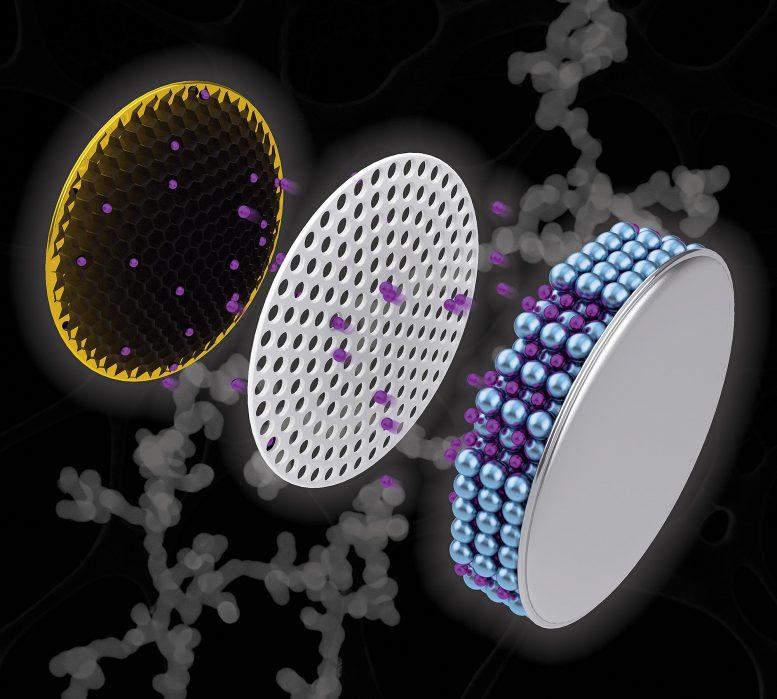
Inventive depiction of a coin cell battery with a copper electrode (left) containing a murky nanochain construction, which researchers admire came upon would possibly perhaps also enhance the skill of a battery and lower charging time. Credit: Purdue University illustration/Henry Hamann
How prolonged the battery of your phone or computer lasts depends upon on how many lithium ions can even be saved in the battery’s harmful electrode self-discipline topic. If the battery runs out of these ions, it would possibly perhaps’t generate an electrical newest to plod a machine and indirectly fails.
Supplies with the next lithium-ion storage skill are both too heavy or the dreadful form to replace graphite, the electrode self-discipline topic currently weak in this day’s batteries.
Purdue University scientists and engineers admire introduced a potential system that these affords would possibly perhaps also very properly be restructured correct into a unique electrode create that would possibly perhaps allow them to prolong a battery’s lifespan, manufacture it extra right and shorten its charging time.
The stare, performing because the quilt of the September teach of Utilized Nano Supplies, created a discover-love construction, called a “nanochain,” of antimony, a metalloid known to enhance lithium-ion charge skill in batteries.
The researchers when compared the nanochain electrodes to graphite electrodes, finding that when coin cell batteries with the nanochain electrode had been handiest charged for 30 minutes, they done double the lithium-ion skill for 100 charge-discharge cycles.
Some kinds of commercial batteries already expend carbon-metallic composites same to antimony metallic harmful electrodes, nonetheless the topic topic tends to magnify as a lot as 3 instances because it takes in lithium ions, causing it to severely change a security hazard because the battery charges.
“You safe to admire to accommodate that form of growth to your smartphone batteries. That system you’re no longer carrying spherical one thing unsafe,” said Vilas Pol, a Purdue affiliate professor of chemical engineering.
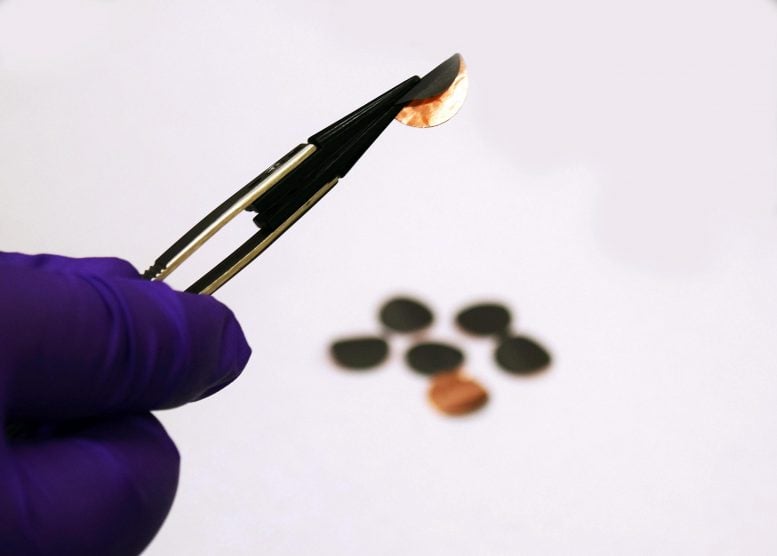
A brand unique methodology would possibly perhaps also allow better affords to fabricate up battery electrodes by changing them correct into a nanochain construction, the murky self-discipline topic on this copper electrode of a coin cell. Credit: Purdue University image/Kayla Wiles
Thru making expend of chemicals – a lowering agent and a nucleating agent – Purdue scientists connected the dinky antimony particles correct into a nanochain form that would possibly perhaps accommodate the specified growth. The notify lowering agent the group weak, ammonia-borane, is to blame for growing the empty areas – the pores interior the nanochain – that accommodate growth and suppress electrode failure.
The group utilized ammonia-borane to a variety of assorted compounds of antimony, finding that handiest antimony-chloride produced the nanochain construction.
“Our map to fabricate the nanoparticles consistently presents the chain structures,” said P. V. Ramachandran, a professor of organic chemistry at Purdue.
The nanochain also keeps lithium-ion skill right for no longer lower than 100 charging-discharging cycles. “There’s if truth be told no change from cycle 1 to cycle 100, so we admire no cause to think that cycle 102 won’t be the same,” Pol said.
Henry Hamann, a chemistry graduate student at Purdue, synthesized the antimony nanochain construction and Jassiel Rodriguez, a Purdue chemical engineering postdoctoral candidate, examined the electrochemical battery performance.
The electrode create has the aptitude to be scalable for bigger batteries, the researchers insist. The group plans to check the create in pouch cell batteries next.
###
This work used to be financially supported by the Herbert C. Brown Center for Borane Analysis.
Reference: “Three-Dimensional Antimony Nanochains for Lithium-Ion Storage” by Jassiel R. Rodriguez, Henry J. Hamann, Garrett M. Mitchell, Volkan Ortalan, Vilas G. Pol and P. Veeraraghavan Ramachandran, 12 August 2019, ACS Utilized Nano Supplies.
DOI: 10.1021/acsanm.9b01316




Leave a comment
Sign in to post your comment or sign-up if you don't have any account.