
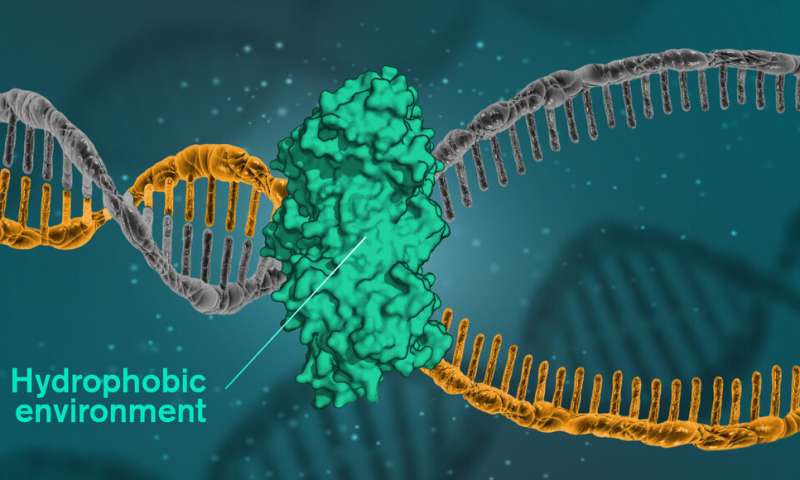
Researchers at Chalmers College of Abilities, Sweden, agree with disproved the prevailing realizing of how DNA binds itself. It is no longer, as is in total believed, hydrogen bonds which bind together the 2 aspects of the DNA constructing. As an alternative, water is the foremost. The invention opens doorways for worth spanking unique idea in analysis in remedy and life sciences. The findings are published in PNAS.
DNA is constructed of two strands consisting of sugar molecules and phosphate groups. Between these two strands are nitrogen bases, the compounds that design up genes, with hydrogen bonds between them. Till now, it became as soon as frequently idea that these hydrogen bonds held the 2 strands together.
But now, researchers from Chalmers College of Abilities demonstrate that the foremost to DNA’s helical constructing might maybe be that the molecules agree with a hydrophobic inner, in an surroundings consisting mainly of water. The environment is on account of this fact hydrophilic, whereas the DNA molecules’ nitrogen bases are hydrophobic, pushing away the surrounding water. When hydrophobic objects are in a hydrophilic surroundings, they team together to diminish their publicity to the water.
The role of the hydrogen bonds, which were previously considered as obligatory to retaining DNA helixes together, seem like extra to form with sorting the grisly pairs so that they hyperlink together in the accurate sequence. The invention is obligatory for idea DNA’s relationship with its surroundings.
“Cells are attempting to protect their DNA, and no longer characterize it to hydrophobic environments, which might most ceaselessly possess sinful molecules,” says Bobo Feng, one of many researchers in the support of the look. “But on the identical time, the cells’ DNA needs to begin up in present to be faded.”
“We factor in that the cell keeps its DNA in a water solution many of the time, but as soon as a cell needs to form something with its DNA, esteem read, reproduction or restore it, it exposes the DNA to a hydrophobic surroundings.”
Copy, for instance, entails the grisly pairs dissolving from one any other and opening up. Enzymes then reproduction either facet of the helix to supply unique DNA. In phrases of repairing damaged DNA, the damaged areas are subjected to a hydrophobic surroundings, to procure changed. A catalytic protein creates the hydrophobic surroundings. This fashion of protein is central to all DNA repairs, which manner it might maybe be the foremost to combating many extreme diseases.
Figuring out these proteins might maybe yield many unique insights into combating resistant bacteria, for instance, or maybe curing cancer. Bacteria direct a protein called RecA to restore their DNA, and the researchers factor in their results might supply unique insight into how this route of works—maybe offering suggestions for stopping it and thereby killing the bacteria.
In human cells, the protein Rad51 repairs DNA and fixes mutated DNA sequences, which otherwise might maybe lead to cancer. “To possess cancer, we desire to realize how DNA repairs. To possess that, we first desire to realize DNA itself,” says Bobo Feng. “To this point, we’ve got no longer, because we believed that hydrogen bonds were what held it together. Now, we’ve got shown that as a exchange it is the hydrophobic forces which lie in the support of it. We agree with additionally shown that DNA behaves fully in a different way in a hydrophobic surroundings. This might well support us to realize DNA, and the easiest intention it repairs. No one has previously positioned DNA in a hydrophobic surroundings esteem this and studied the easiest intention it behaves, so or no longer it is a ways no longer just that no-one has stumbled on this till now.”
The researchers additionally studied how DNA behaves in an surroundings that is extra hydrophobic than fashionable, a manner they were the principle to experiment with. They faded the hydrophobic solution polyethylene glycol, and adjusted the DNA’s atmosphere step-by-step from the naturally hydrophilic surroundings to a hydrophobic one. They aimed to verify if there might be a restrict where DNA starts to lose its constructing, when the DNA does no longer agree with a motive to bind, since the environment is no longer any longer hydrophilic. The researchers noticed that after the solution reached the borderline between hydrophilic and hydrophobic, the DNA molecules’ characteristic spiral design began to unravel.
Upon closer inspection, they noticed that after the grisly pairs wreck up from one any other (on account of external influence, or simply from random actions), holes are fashioned in the reach, permitting water to leak in. Because DNA needs to possess its inner dry, it presses together, with the grisly pairs coming together all all over again to squeeze out the water. In a hydrophobic surroundings, this water is lacking, so the holes cease in area.
“Hydrophobic catalysis and a seemingly biological role of DNA unstacking prompted by surroundings results” is published in Proceedings of the National Academy of Sciences (PNAS).
Extra recordsdata:
Bobo Feng et al, Hydrophobic catalysis and a seemingly biological role of DNA unstacking prompted by surroundings results, Proceedings of the National Academy of Sciences (2019). DOI: 10.1073/pnas.1909122116
Citation:
DNA is held together by hydrophobic forces (2019, September 23)
retrieved 23 September 2019
from https://phys.org/news/2019-09-dna-held-hydrophobic.html
This file is area to copyright. Other than any sexy dealing for the rationale for deepest look or analysis, no
section might maybe be reproduced with out the written permission. The shriek material is provided for recordsdata applications simplest.




Leave a comment
Sign in to post your comment or sign-up if you don't have any account.