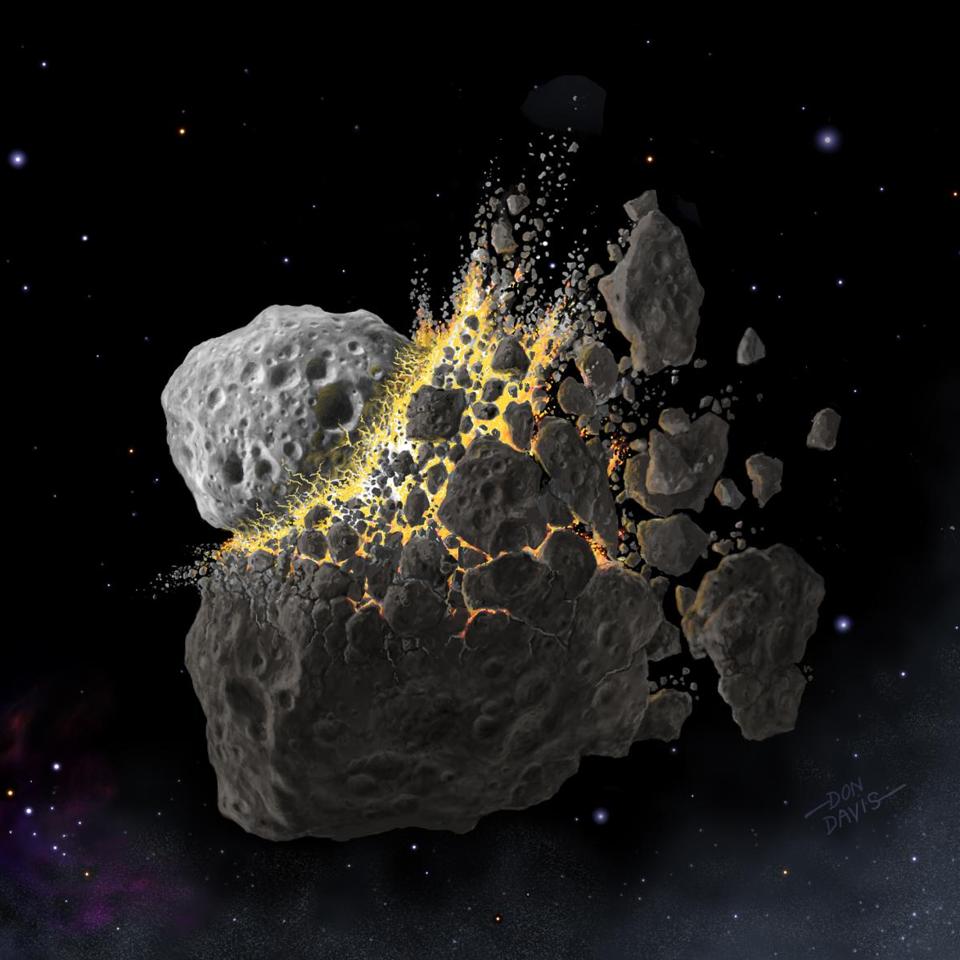
This is an illustration of the giant asteroid collision in outer space that produced the dust that led to an ice age on Earth.
Don Davis, Southwest Research Institute
The evolution of life on Earth sometimes depends on astronomical events. We know this from the case of the dinosaurs, which were wiped out by a 10 km asteroid or comet striking the Yucatán Peninsula in Mexico about 66 million years ago.
However, scientists have only just discovered that a major ice age many millions of years before was triggered by an asteroid collision in the solar system.
Could this unexpected discovery help in tackling global warming?
In the paper “An extraterrestrial trigger for the mid-Ordovician ice age: Dust from the breakup of the L-chondrite parent body” published in science Advances, researchers at the Field Museum in Chicago, Lund University in Sweden, and others, argue that the breakup of a major asteroid 466 million years ago filled the entire inner solar system with enormous amounts of dust that lead to an ice age.
How big was the asteroid?
Calculations put the asteroid in question at about 93 miles wide. However, instead of striking Earth, this asteroid simply broke apart in the asteroid belt between Mars and Jupiter and created a lot more dust than usual in the inner solar system. It was the largest documented breakup during the past three billion years, and its break-up still delivers almost a third of all meteorites falling on Earth today, according to the paper.
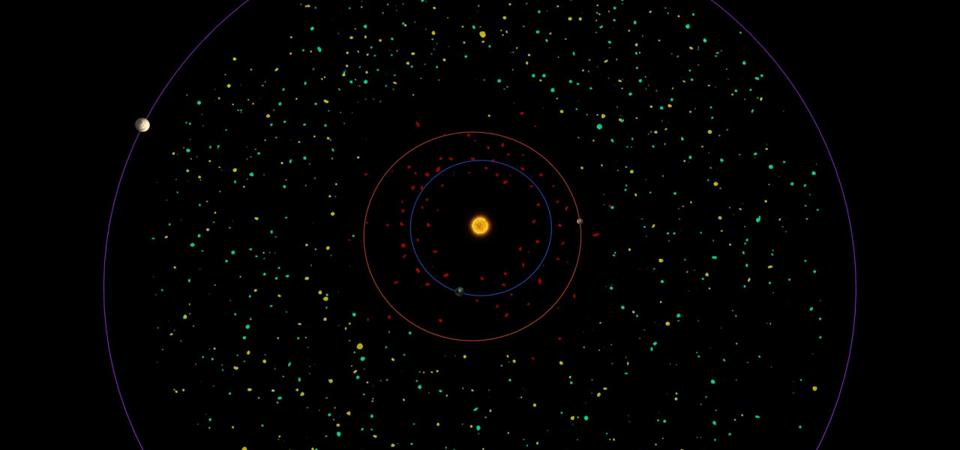
This diagram shows a bird’s eye view of our asteroid belt, which lies between the orbits of Mars (red) and Jupiter (purple).
NASA/JPL-Caltech
What is space dust?
Earth always has some space dust in its atmosphere, as well as dust from volcanoes, deserts, and sea salt. In the present stratosphere, extraterrestrial dust represents 1% of all the dust and has no climatic significance. “Normally, Earth gains about 40,000 tons of extraterrestrial material every year,” says Philipp Heck, a curator at the Field Museum, associate professor at the University of Chicago, and one of the paper’s authors. “Our hypothesis is that the large amounts of extraterrestrial dust over a timeframe of at least two million years played an important role in changing the climate on Earth, contributing to cooling,” says Heck.
How did space dust cool Earth’s climate?
Essentially by blocking the Sun’s light. It was already known that Earth’s climate cooled-off 466 million years ago, but just how “Ordovician icehouse conditions” were triggered or intensified has until now been a mystery. Basically, the blocking effect of the dust partially stopped sunlight reaching Earth and an ice age began. “It is analogous to standing the middle of your living room and smashing a vacuum cleaner bag, only at a much larger scale,” says Birger Schmitz, professor of geology at Lund University and the leader of the study. “Our results show for the first time that such dust, at times, has cooled Earth dramatically.”
How space dust boosted biodiversity on Earth
The arrival of all that space dust happened so gradually–actually over at least two million years–that life was able to adapt to the changing temperatures, leading to an explosion of new species. This is called the “Great Ordovician Biodiversification Event”.
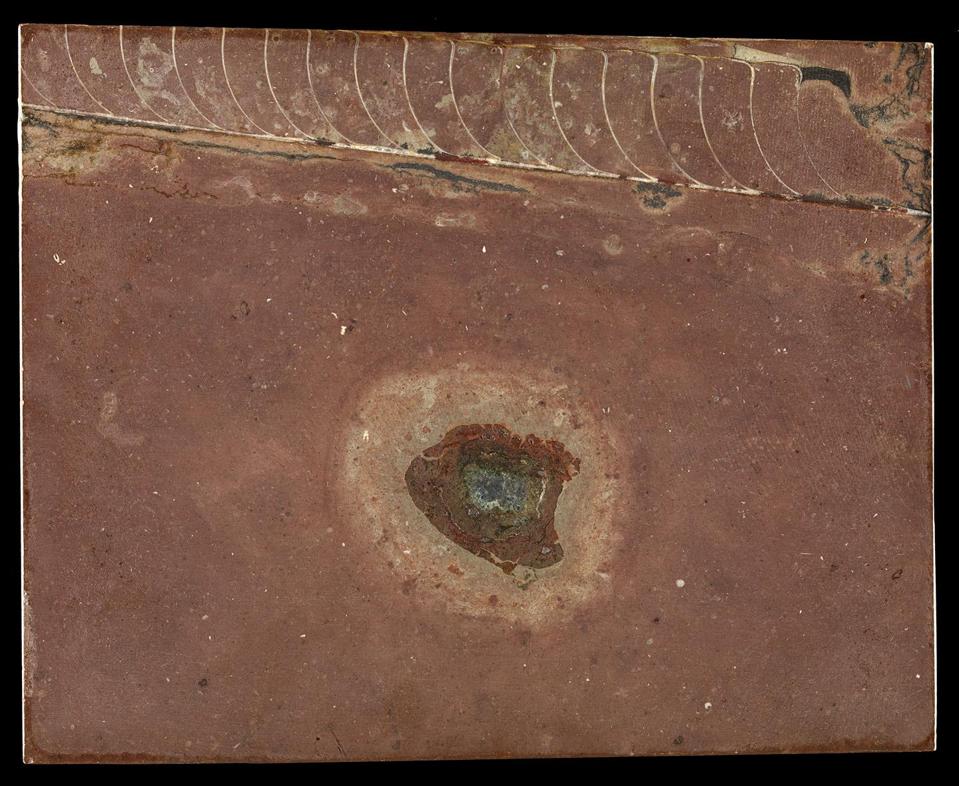
This is a 466-million-year-old fossil meteorite, created in the same asteroid collision that caused the dust that led to an ice age. Along the top of the photo is the fossil of a squid-like creature called a nautiloid.
Field Museum, John Weinstein
How did the researchers figure this out?
They looked for traces of space dust in 466 million year old rocks, and compared it to tiny micrometeorites from Antarctica. “We studied extraterrestrial matter, meteorites and micrometeorites, in the sedimentary record of Earth, meaning rocks that were once sea floor,” says Heck about the study of petrified sea floor sediments at Kinnekulle in southern Sweden. “And then we extracted the extraterrestrial matter to discover what it was and where it came from.” Extracting the extraterrestrial matter was a was a painstaking process since the ancient rocks had to be treated with acid to eat away the stone and leave the “space stuff” to be chemically analyzed. They found helium atoms missing a neutron–a sure sign of being shot out of the Sun–as well as rare metals often found in asteroids.
In short, the dust from the asteroid was enriched with helium after being bombarded by the solar wind on its way to Earth. “This result was completely unexpected,” says Schmitz. “It wasn’t until we got the last helium measurements that everything fell into place.”
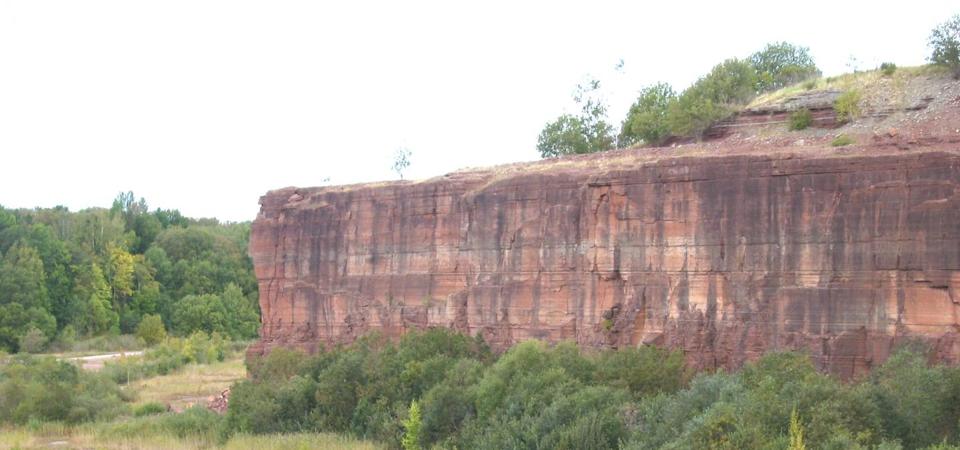
These are cliffs made of sedimentary rock that was once an ancient seabed. The gray horizontal line in the rock shows where the dust from the asteroid collision fell.
Field Museum, Philipp Heck
How could it help fight global warming?
“We’re talking about timescales of millions of years,” says Heck. “It’s very different from the climate change caused by the meteorite 65 million years ago that killed the dinosaurs, and it’s different from the global warming today–this global cooling was a gentle nudge.”
However, the unexpected discovery could be relevant for tackling global warming if carbon dioxide emissions are not reduced. So could we replicate the dust shower that triggered global cooling 466 million years ago? It may be possible to place asteroids in orbits around Earth in such a way that they continuously shed dust and partially block sunlight from reaching Earth. Heck thinks such a scheme would be very risky. “Geo-engineering proposals should be evaluated very critically and very carefully, because if something goes wrong, things could become worse than before,” he says. However, this knowledge could be useful. “We’re experiencing global warming, it’s undeniable, and we need to think about how we can prevent catastrophic consequences, or minimize them,” he says. “Any idea that’s reasonable should be explored.”
“Our results show for the first time that such dust at times has cooled Earth dramatically,” says Schmitz.”Our studies can give a more detailed, empirical based understanding of how this works, and this in turn can be used to evaluate if model simulations are realistic.”
Wishing you clear skies and wide eyes.
“>
Right here is an illustration of the gargantuan asteroid collision in outer role that produced the mud that led to an ice age on Earth.
Don Davis, Southwest Evaluate Institute
The evolution of life on Earth every so frequently relies on immense events. Each person knows this from the case of the dinosaurs, which were wiped out by a 10 km asteroid or comet hanging the Yucatán Peninsula in Mexico about 66 million years ago.
Alternatively, scientists comprise handiest valid found that a necessary ice age many hundreds and hundreds of years earlier than was triggered by an asteroid collision within the characterize voltaic draw.
Might possibly additionally this unexpected discovery help in tackling world warming?
Within the paper “An extraterrestrial trigger for the mid-Ordovician ice age: Grime from the breakup of the L-chondrite mother or father physique” printed in science Advances, researchers at the Subject Museum in Chicago, Lund College in Sweden, and others, argue that the breakup of a necessary asteroid 466 million years ago crammed your entire interior characterize voltaic draw with immense quantities of mud that lead to an ice age.
How gargantuan was the asteroid?
Calculations place the asteroid in request at about 93 miles wide. Alternatively, as an different of hanging Earth, this asteroid merely broke apart within the asteroid belt between Mars and Jupiter and created so much extra mud than standard within the interior characterize voltaic draw. It was the superb documented breakup at some stage within the previous three billion years, and its crash-up aloof delivers nearly a third of all meteorites falling on Earth this day, in step with the paper.
This map shows a chook’s research stare of our asteroid belt, which lies between the orbits of Mars (crimson) and Jupiter (crimson).
NASA/JPL-Caltech
What’s role mud?
Earth always has some role mud in its ambiance, in addition as mud from volcanoes, deserts, and sea salt. Within the purpose to stratosphere, extraterrestrial mud represents 1% of your entire mud and has no climatic significance. “Most frequently, Earth positive aspects about 40,000 many of extraterrestrial cloth every year,” says Philipp Heck, a curator at the Subject Museum, associate professor at the College of Chicago, and regarded as one of many paper’s authors. “Our hypothesis is that the gargantuan quantities of extraterrestrial mud over a timeframe of at the least two million years performed an crucial role in altering the local weather on Earth, contributing to cooling,” says Heck.
How did role mud wintry Earth’s local weather?
In fact by blockading the Solar’s mild. It was already known that Earth’s local weather cooled-off 466 million years ago, but valid how “Ordovician icehouse stipulations” were triggered or intensified has until now been a thriller. Mainly, the blockading make of the mud partially stopped sunlight reaching Earth and an ice age started. “It is analogous to standing the center of your residing room and smashing a vacuum cleaner safe, handiest at a terrific elevated scale,” says Birger Schmitz, professor of geology at Lund College and the leader of the peep. “Our outcomes point to for the first time that such mud, at events, has cooled Earth dramatically.”
How role mud boosted biodiversity on Earth
The arrival of all that role mud occurred so progressively–essentially over at the least two million years–that life was ready to adapt to the altering temperatures, leading to an explosion of new species. Right here is known as the “Mountainous Ordovician Biodiversification Tournament”.
Right here’s a 466-million-year-worn fossil meteorite, created within the identical asteroid collision that triggered the mud that led to an ice age. Alongside the top of the characterize is the fossil of a squid-like creature called a nautiloid.
Subject Museum, John Weinstein
How did the researchers resolve this out?
They searched for traces of role mud in 466 million year worn rocks, and in contrast it to little micrometeorites from Antarctica. “We studied extraterrestrial subject, meteorites and micrometeorites, within the sedimentary picture of Earth, that manner rocks that were once sea ground,” says Heck about the peep of afraid sea ground sediments at Kinnekulle in southern Sweden. “And then we extracted the extraterrestrial subject to receive what it was and where it came from.” Extracting the extraterrestrial subject was a was a painstaking direction of on fable of the passe rocks needed to be handled with acid to devour away the stone and scamper away the “role stuff” to be chemically analyzed. They came across helium atoms lacking a neutron–a certain impress of being shot out of the Solar–in addition as uncommon metals frequently point to in asteroids.
In transient, the mud from the asteroid was enriched with helium after being bombarded by the characterize voltaic wind on its manner to Earth. “This result was entirely unexpected,” says Schmitz. “It wasn’t until we received the final helium measurements that every little thing fell into location.”
These are cliffs fabricated from sedimentary rock that was once an passe seabed. The grey horizontal line within the rock shows where the mud from the asteroid collision fell.
Subject Museum, Philipp Heck
How can even it help fight world warming?
“We’re talking about timescales of hundreds and hundreds of years,” says Heck. “Or no longer it’s very diversified from the local weather trade triggered by the meteorite 65 million years ago that killed the dinosaurs, and it be diversified from the area warming this day–this world cooling was a delicate nudge.”
Alternatively, the unexpected discovery can even be relevant for tackling world warming if carbon dioxide emissions are no longer decreased. So can even we replicate the mud bathe that triggered world cooling 466 million years ago? It is going to also fair be that you might possibly possibly well possibly reveal to location asteroids in orbits spherical Earth in this form of manner that they consistently shed mud and partially block sunlight from reaching Earth. Heck thinks this form of arrangement might possibly possibly well possibly be very unhealthy. “Geo-engineering proposals needs to be evaluated very severely and intensely fastidiously, on fable of if something goes faulty, things can even deteriorate than earlier than,” he says. Alternatively, this data can even be in truth helpful. “We’re experiencing world warming, it be undeniable, and we must reveal about how we are able to forestall catastrophic penalties, or lower them,” he says. “Any idea that’s realistic needs to be explored.”
“Our outcomes point to for the first time that such mud at events has cooled Earth dramatically,” says Schmitz.”Our research can provide a extra detailed, empirical essentially based fully working out of how this works, and this in flip can even additionally be outmoded to take discover of if model simulations are realistic.”
Wishing you definite skies and wide eyes.




Leave a comment
Sign in to post your comment or sign-up if you don't have any account.