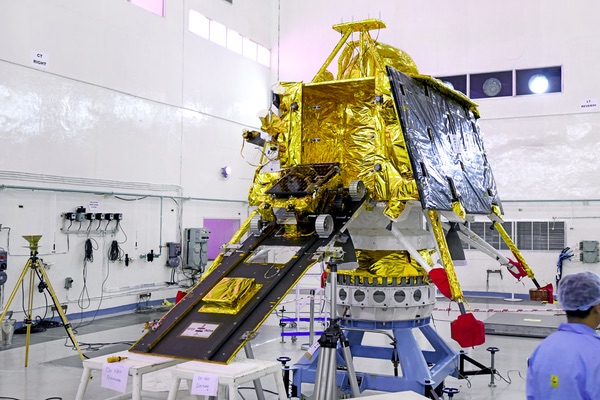
The Vikram lander, which carried a itsy-bitsy rover known as Pragya, being ready for open earlier this year. ISRO lost contact with the lander for the length of its descent to the lunar ground earlier this month. (credit score: ISRO) by Ajey Lele
|

| Date | Orbit-elevating manoeuvre | Proposed | Exact | Deviation |
| 24 July | First | 230 x 45162 km | 230 X 45,163 km | 1 km |
| 26 July | 2nd | 250 x 54,689 km | 251 X 54,829 km | 1 x 140 km |
| 29 July | Third | 268 x 71,558 km | 276 x 71,792 km | 8 x 234 km |
| 02 Aug | Fourth | 248 x 90,229 km | 276 x 71,792 km | 29 x 757 km |
| 06 Aug | Fifth (closing) | 221 x 143,585 km | 276 x 142,975 km | 55 x 610 km |
| 14 Aug | Trans | Lunar | Insertion | (TLI) |
| 20 Aug | Moon Entry | 118 x 18,078 km | 114 x 18,072 km | 4 x 6 km |
| 21 Aug | 2nd Lunar orbit manoeuvre | 121x 4303 km | 118 x 4412 km | 3×10⁹ km |
| 28 Aug | Third | 178 x 1,411 km | 179 x 1412 km | 1 x 1 km |
| 30 Aug | Fourth | 126×164 km | 124 x 164 km | 2 km |
| 01 Sep | Fifth | 114x 128 km | 119 x 127 km | -5 x 1 km |
| 02 Sep | Lander | separated | from | Orbiter |
| 02 Sep | 119 x 127 km | |||
| De-orbiting | manoeuvre | |||
| 03 Sep | first | 109 x 120 km | 104 x 128 km | 5 x-8 km |
| 04 Sep | second | 36 x 110 km | 35 x 101 km | -1x 9 km |
| 07 Sep | Exhausting | Landing | Took place |
This desk implies that on about a events there had been important deviations between proposed and genuine orbits. But they’ll be arrangement to be less important from the level of peek of the health of the mission, for those that’ve in suggestions the quantity of the distance the orbiter became as soon as travelling.
Is it a failure of autonomy?
For any planetary exploration, touchdown on the bottom of a planet is basically the most challenging segment for the mission. The chairman of ISRO had indubitably pronounced on varied events that the final segment of the mission which involves the controlled (powered) touchdown is going to be terrorizing! This alive to the lumber back and forth of lander for final 35 kilometers. This lumber back and forth became as soon as to prefer 15 minutes, and get hang of turn into identified because the “15 minutes of fear.”
In shut to future, after enterprise the detailed fault evaluate, ISRO can deem of repeating the mission.
Every thing became as soon as supposed to happen in self sustaining mode for the length of this 15-minute length of descent. The ISRO Chairman said, “We is not any longer going to enact anything else… We is not any longer going to interrupt. It is total autonomy. We are doing this for the first time.” A deviation in the trajectory, 12 minutes into the descent, became as soon as considered. Clearly, the arrangement malfunctioned for the length of the self sustaining mode. Presumably, the tempo became as soon as bigger than required at that height. There is additionally a peek that the be concerned might well perhaps get hang of alive to some extra or less glitch in the functioning of engines archaic in the descent. All in all, whatever might be the be concerned, the arrangement didn’t lumber in safe-mode expecting the considerations. Did this happen since the lander became as soon as very shut to the touchdown blueprint for the arrangement to prefer any corrective measures?
It is no longer the cause right here to undertake any detailed failure evaluate. Broadly, it shall be inferred that the arrangement became as soon as no longer professional adequately to call the fault and prefer corrective measures. The energy of autonomy of any arrangement would count upon the classic create components. The create might well perhaps be mainly per what the scientists and technologists await as doable anomalies and feed them in the arrangement. In total, self sustaining programs feature in advanced and commence-ended environments with high ranges of independence. They are expected to be taught and reason with themselves. As successfully as, they are designed in this kind of methodology that they would name the unforeseen changes in time and acknowledge accordingly. What isn’t publicly identified is the nature and quality of man made intelligence (AI) serious about complete strategy of touchdown of the lander Vikram. The rover became as soon as supposed to be a fully AI-based exclusively mostly product. On the other hand, because it didn’t get hang of another option to feature, no judgement would be made in that regard. It’ll be very refined to quantify the role, if any, performed by AI for the length of old short while of the mission. AI works on files inputs and for such abnormal missions it’s no longer going that required files would get hang of been on hand in abundance. As such, globally definite limitations of AI are been constantly debated. It seems to be that field, which is an files sparse predicament, might well perhaps additionally simply no longer be a correct predicament for keeping blind faith in AI.
The methodology forward
Broadly, it shall be said that ISRO led a indubitably entertaining Moon campaign, nonetheless failed to administer a delicate-touchdown for its lander Vikram. In shut to future, after enterprise the detailed fault evaluate, ISRO can deem of repeating the mission (negate, Chandrayaan 2R) by enterprise required corrections. Already they’ve an operational orbiter spherical the Moon. They know how contend with deep field communications. In total, field agencies develop two units of 1 instruments (one primary and one spare). There is a chance that ISRO might well additionally get hang of an additional pair of lander-rover programs on hand to try every other time.
Dr. Ajey Lele is a senior fellow at the Institute For Defence Reviews and Analyses (IDSA), a New Delhi-based exclusively mostly deem tank on security disorders. He’s a postgraduate in physics and has a doctorate in global family members. His be taught focal level is on strategic applied sciences and WMD linked disorders. He has several publications to his credit score.
Level to: we’re speedily moderating all feedback subcommitted to tackle a surge in unsolicited mail.




Leave a comment
Sign in to post your comment or sign-up if you don't have any account.