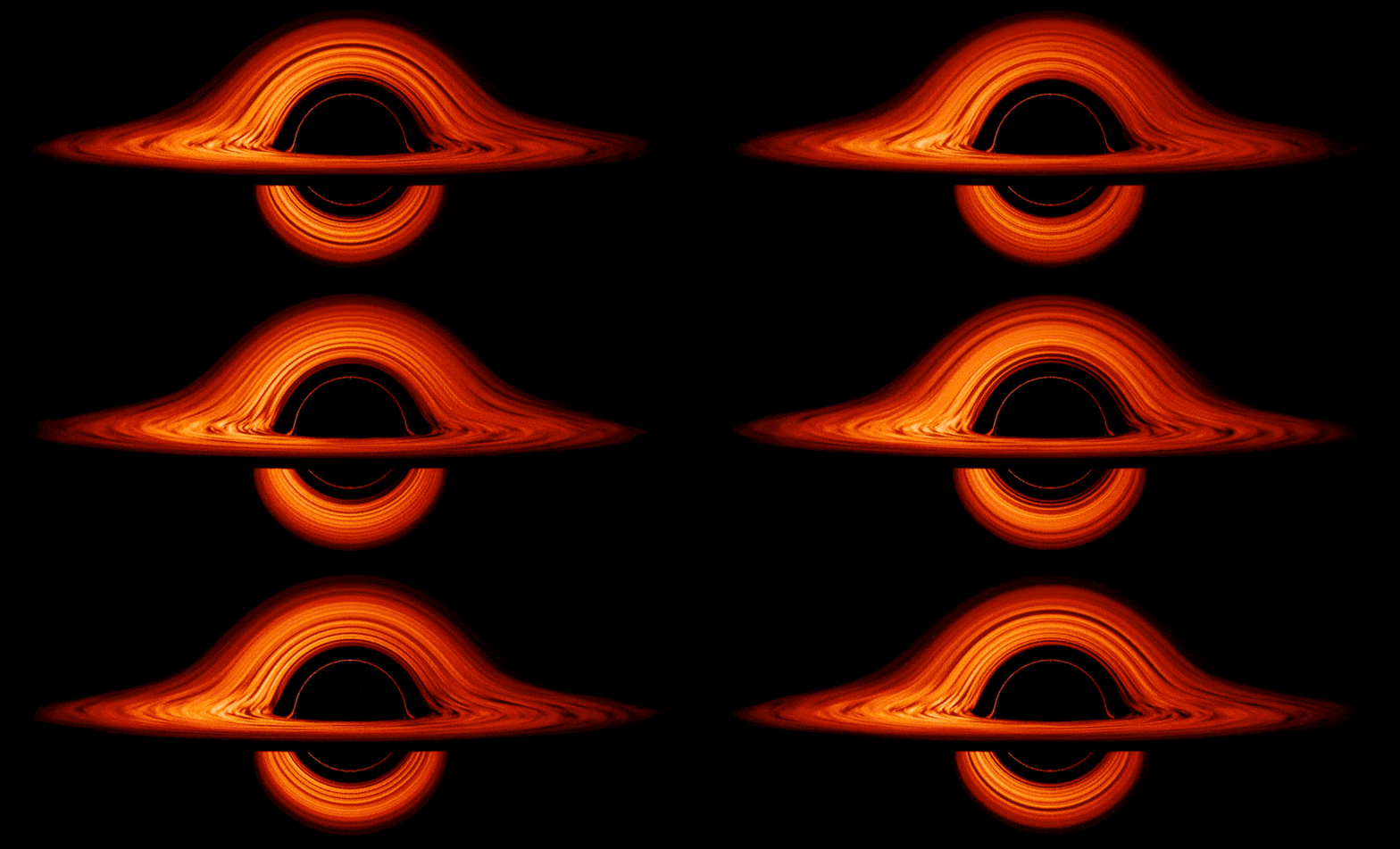
(NASA’s Goddard Condo Flight Center/Jeremy Schnittman)
MICHELLE STARR
26 SEP 2019
The first-ever order listing of a sad gap‘s match horizon used to be a basically spectacular feat of scientific ingenuity. However it absolutely used to be extraordinarily advanced to make, and the following listing used to be barely low-resolution.
Tactics and know-how may maybe maybe be delicate, and it be expected that future order photos of sad holes will enhance with time. And a brand recent NASA visualisation – made for the company’s Shaded Hole Week – reveals what we would quiz to perceive in high-resolution photos of an actively accreting supermassive sad gap.
supermassive sad holes take a seat on the centres of most huge galaxies, and the way in which they got there may maybe be a mystery; which came first, the sad gap or the galaxy, is among the mountainous questions in cosmology.
What we make know is that they’re basically monumental, as in millions or billions of times the mass of the Solar; that they can protect a watch on essential person formation; that after they accumulate up and start feeding, they’ll change into the brightest objects within the Universe. Over the a long time, we be pleased additionally found out some of their weird and wonderful dynamics.
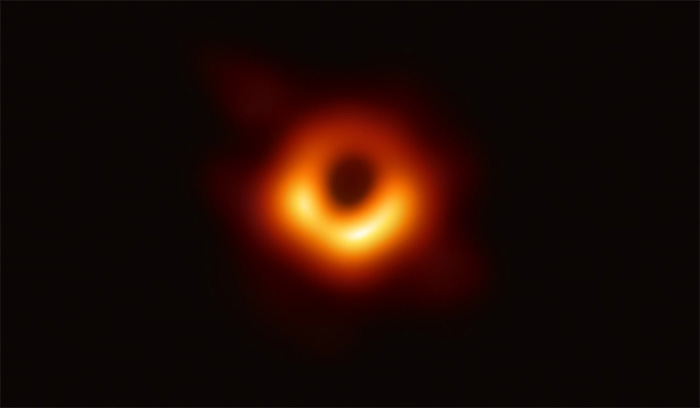 First-ever order listing of a sad gap, M87*. (EHT Collaboration)
In actuality, the very first simulated listing of a sad gap, calculated the sigh of a 1960s punch card IBM 7040 computer and plotted by hand by French astrophysicist Jean-Pierre Luminet in 1978, soundless appears to be like to be like lots like NASA’s simulation.
In each simulations (the recent one above, and Luminet’s work below), you search a sad circle within the centre. That’s the match horizon, the point at which electromagnetic radiation – gentle, radio waves, X-rays etc – need to no longer any longer mercurial enough to make spoil out bustle from the sad gap’s gravitational pull.
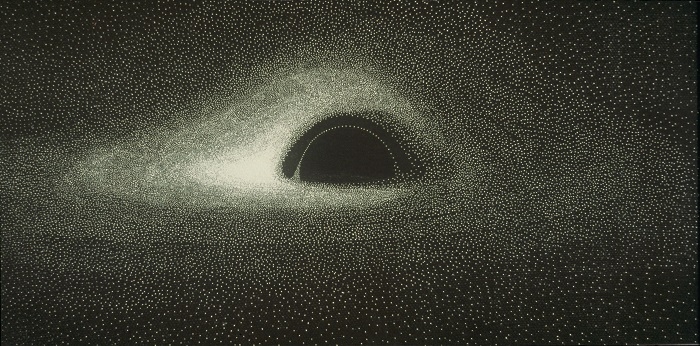 (Jean-Pierre Luminet)
Staunch by the middle of the sad gap is the front of the disc of subject materials that’s swirling spherical the sad gap, like water exact into a drain. It generates such intense radiation by friction that we’re going to detect this piece with our telescopes – that’s what you is at bother of be seeing within the listing of M87*.
You will search the photon ring, an ideal ring of gentle spherical the match horizon. And likewise you are going to be in a hassle to search a substantial sweep of gentle spherical the sad gap. That gentle is basically coming from the piece of the accretion disc on the support of the sad gap; however the gravity is so intense, even outdoor the match horizon, that it warps spacetime and bends the course of gentle spherical the sad gap.
It’s likely you’ll also search that one facet of the accretion disc is brighter than the assorted. This make continuously known as relativistic beaming, and it be resulted in by the rotation of the disc. The piece of the disc that’s interesting against us is brighter since it is miles interesting shut to gentle-bustle. This motion produces a trade in frequency within the wavelength of the sunshine. It’s called the Doppler make.
The facet that’s interesting far from us, therefore, is dimmer, because that motion has the reverse make.
“It’s precisely this solid asymmetry of obvious luminosity,” Luminet wrote in a paper closing yr, “that is the first signature of a sad gap, basically the most efficient celestial object in a hassle to give the inside of areas of an accretion disk a bustle of rotation shut to the bustle of gentle and to induce a extraordinarily solid Doppler make.”
Simulations equivalent to these can reduction us understand the intense physics spherical supermassive sad holes – and that helps us understand what we are seeing when we search on the listing of M87*.




Leave a comment
Sign in to post your comment or sign-up if you don't have any account.