Planets draw in all sha… planets draw in various sizes. Nevertheless, a number of of the most putting traits that predicament them apart are their bodily and chemical particularities, which we relate to categorize the myriad of planets we’ve uncover in space.

I esteem planets. I esteem them so great I dwell to instruct the story one. They’re heavy adequate for gravity to pick out up them spherical, their orbits are sure of particles, and they don’t burn esteem stars originate. Nevertheless, there’s a host of variation in what they’re and the journey they provide.
So, today time, I’d belief it may maybe well also be appealing to scrutinize at the total a host of styles of planets — a number of of which we’ve seen within the nice expanse of space, a number of of which we’re most efficient looking ahead to to uncover. In no specific checklist, they’re:
Brown Dwarfs

Image credits NASA / JPL-Caltech.
A celeb is a snug intention where gravity compresses and heats all the pieces up whereas the nuclear fusion at their core pushes outwards. With too great tension, electrons can’t switch freely, so the reaction stops. With too great ‘pronounce’, there’s not adequate tension to withhold the reaction going.
Teetering on the perimeter of starhood, brown dwarfs devour outgrown any definition of a ‘planet’. Yet, they’re stunning not pretty a celebrity. Ranging from 13 to 80 cases the mass of Jupiter, brown dwarfs are expansive embers barreling through space, fusing deuterium and lithium to withhold themselves a little bit of alight. Nevertheless, they need yet more topic to be ready to fight their very possess gravity, so they’ll’t ignite.
Brown dwarfs aren’t planets. They don’t include esteem planets — they include esteem stars. As a replace of subject topic slowly clumping collectively, brown dwarfs are born from clouds of gas collapsing in on themselves.
Gasoline Giants

Image credits NASA / JPL-Caltech.
The chonk de la chonk, gas giants are the superb planets to ever dot the universe. They’re detached basically (>90%) of hydrogen and helium (the two easiest ingredients within the periodic desk) with traces of alternative compounds thrown in for factual measure. Hydrogen and helium give these planets an overall brown-yellow-ocher palette, with water and ammonia clouds peppering their absolute best layers white. Owing to the nature of their bodies, these giants are blanketed by wild storms and excited winds.
We don’t know great about their cores, most efficient that it must be immensely hot (spherical 20,000 Kelvin, K) and pressurized in there. The main hypotheses take that gas giants either devour molten rocky cores surrounded by roiling oceans of gas, diamond cores, or ones made of fleshy-forced (steel) hydrogen nuggets.

Image credits NASA / JPL-Caltech.
They’re normally known as ‘failed stars’ because those two gases are what keeps stars working, but gas giants don’t devour adequate mass to spark nuclear fusion. We devour two of them within the photo voltaic intention, Jupiter and Saturn.
Most exoplanets we’ve stumbled on to date are gas giants — stunning because they’re astronomical and more uncomplicated to position.
Ice Giants

Image credits NASA / JPL-Caltech / Kevin M. Gill.
A good deal like gas giants but won’t return your texts. Ice giants are believed to swap out hydrogen and helium (below 10% by weight) in prefer of oxygen, carbon, nitrogen, and sulfur, that are heavier. Boiled down, we don’t for sure know what ingredients these planets are made of — their (admittedly skinny) hydrogen envelopes conceal the interior of the planets, so we can’t stunning sprint scrutinize. This outer layer is believed to carefully resemble the nature of gas giants.
Tranquil, it is believed that, whereas not utterly made of the ice we know and love here on Earth exactly, there may maybe be water and water ice in their pick up-up. They secure their title from the undeniable fact that nearly all of their constituent topic changed into stable as the planets had been forming, and because planetary scientists focus on with ingredients with freezing functions above about 100 K (much like water, ammonia, or methane) as “ices”.

Image credits MarioProtIV / Wikimedia.
Ice giants are, as per their title, pretty large, but they are usually smaller than gas giants. Nevertheless, owing to their great-denser pick up-up, they’re moreover more large overall. There are two ice giants in our photo voltaic intention, Uranus and Neptune. Water, within the include of a supercritical ocean underneath their clouds, is believed to account for roughly two-thirds of their entire mass.
Both ice giants and gas giants devour main atmospheres. The gas they’re comprised of changed into accreted (captured) as the planets had been forming.
Rocky Planet

Image in Public Enviornment.
Additionally known as terrestrial or telluric planets (from the Latin word for Earth), they’re formed basically of rock and steel. Their main feature is that they devour a stable surface. Mercury, Venus, Earth, and Mars, the first four from the Solar, are the rocky planets of our photo voltaic intention.
To the superb of our info rocky planets are formed spherical a steel core, even though the hypothesis of coreless planets has been floated spherical.
Atmospheres, within the event that they devour one, are secondary — formed from captured comets or created through volcanic or biological relate. Rocky planets moreover include main atmospheres but fail to withhold them. Secondary atmospheres are great thinner and more relaxing than those of Saturn or Uranus. That’s not to reveal a secondary ambiance can’t affect its planet: Venus’s rampant climate catastrophe is a good instance.

Image credits NASA.
Mercury, with a steel core of 60–70% of its planetary mass, is as shut as we’ve stumbled on to an Iron planet. Both it and the contrivance more bling Carbon planets thus dwell hypothetical. One other appealing and frigid-named hypothetical class of rocky planets are Chthonians, the rock or steel cores of gas giants stripped naked.
Rocky worlds can harbor liquid water, terrain aspects, and doubtlessly tectonic relate. Tectonically-active planets can moreover generate a magnetic subject.

Image through Wikimedia.
Such planets draw in many replace sizes. Earth is Earth-sized, Mercury is most efficient about one third of it, whereas Kepler-10c is 2.35 cases as mammoth as our planet. Density is moreover a factor. Without going to a planet and studying its interior structure, it’s not likely to accurately estimate its density. As a rule of thumb, on the other hand, uncompressed density estimates for a rocky planet are usually decrease the farther away it orbits its star. It’s most likely that planets closer to the star would thus devour a better steel (denser) grunt material, whereas those extra away would devour better silicate (lighter) grunt material. Gliese 876 d is 7 to 9 cases the mass of Earth.
The main extrasolar rocky planets had been uncover within the early 1990s. Paradoxically, they had been stumbled on orbiting a pulsar (PSR B1257+12), one of the well-known most violent environments that it is probably going you’ll maybe well imagine for a planet. Their estimated hundreds had been 0.02, 4.3, and 3.9 cases that of Earth’s.
Ocean planets

Its moreover an ocean moon.
Image through Wikimedia.
Planets that own a mammoth quantity of water, either on the skin or subsurface. They’re an offshoot of the rocky planet, either covered in liquid water or an ice layer over liquid water. We don’t know very great about them or how many there are available because we can’t yet set up liquid surface water, so we relate ambiance spectrometry as a proxy.
Earth is the superb planet on which we’ve confirmed the existence of liquid water at the skin to date. And even though water does conceal spherical 71% of the Earth, it most efficient makes up for 0.05% of its mass, so we’re not an Ocean planet. On these latter ones, waters are expected to creep so deep that they would flip to (warm) ice even at excessive temperatures (attributable to the tension).
This kind of planet stays one of the well-known likeliest to harbor extraterrestrial lifestyles.
Dwarf planets
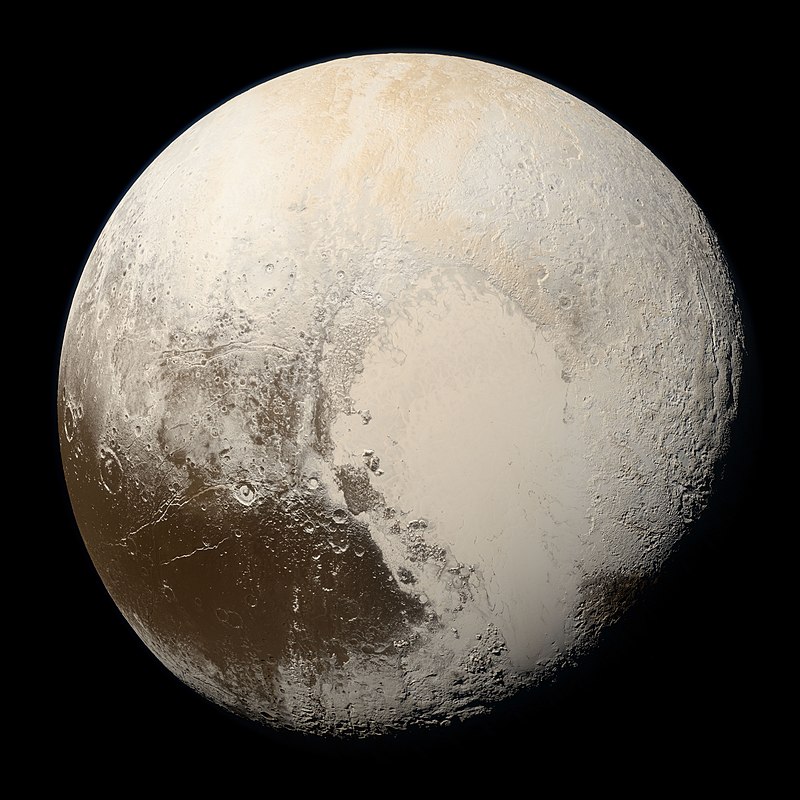
Image through Wikimedia.
Fan-celebrated Pluto, alongside with Ceres, Haumea, Makemake, and Eris are the dwarf planets of our photo voltaic intention. Dwarf planets roughly bolt the road between planets and natural satellites. They’re mammoth adequate to take their very possess stable form, even to take moons themselves, but not adequate to sure their orbit of alternative subject topic.
Moons

Image credits NASA / JPL-Caltech / College of Nantes / College of Arizona.
No longer technically planets because they orbit every other planet, moons are nonetheless telluric bodies that modify in dimension from ‘mammoth asteroid’ to ”better than Mercury’. Titan, Saturn’s largest moon, has its possess ambiance.
There are six planets within the Record voltaic Device that sum up to 185 known natural satellites, whereas Pluto, Haumea, Makemake, and Eris moreover harbor their very possess moons.
Rogue planets
These are the planets your fogeys warned you about.
Rogue planets deserve a uncover on this checklist regardless that they don’t orbit a celebrity. They’re, for all intents and functions, planets that orbit the galactic core after being ejected from the planetary intention throughout which they formed. It is moreover that it is probably going you’ll maybe well imagine that, someway, they formed freed from any stellar host. PSO J318.5−22 is one such planet.




Leave a comment
Sign in to post your comment or sign-up if you don't have any account.