
MICHELLE STARR
5 SEP 2019
No matter its celebrated image of teeth and claws and snarl, Tyrannosaurus rex became as soon as no sizzling-head. New research indicates that the two mysterious holes in the stop of the dinosaur’s cranium seemingly helped regulate temperatures inner its head.
Beforehand, these holes – called the dorsotemporal fenestra – were regarded as stuffed with muscle tissue that helped purpose the extremely efficient jaw. But, based fully on anatomist Casey Holliday of the College of Missouri, something didn’t rather add up.
“It’s in actuality uncommon for a muscle to come encourage up from the jaw, assemble a 90-degree turn, and saunter along the roof of the cranium,” he stated.
“But, now we private rather a couple of compelling proof for blood vessels on this condominium, in step with our work with alligators and assorted reptiles.”
A similar fenestra would possibly moreover be stumbled on in the skulls of a class of animals identified as diapsids, grouped collectively for that reason characteristic. This class entails now not most titillating crocodilians, but also birds, lizards, and tuatara; the holes are thought to private developed about 300 million years previously.
Fenestra are now not stumbled on in all dinosaur skulls, but these that attain private them embody tyrannosaurs and pterosaurs. To begin figuring out what these holes were for, the team analysed assorted diapsid skulls to resolve which ones had fenestra most same to T. rex; the closest similarities grew to alter into out to be with crocodilians.
So, Holliday and his co-authors – William Porter and Lawrence Witmer from Ohio College, and Kent Vliet of the College of Florida – took thermal imaging cameras and went to scrutinize a bunch of alligators on the St Augustine Alligator Farm Zoological Park.
On account of alligators are cold-blooded, or ectothermic, their physique temperature depends on the temperature of their surroundings. This implies that their thermoregulation processes are very assorted from warm-blooded, or endothermic, organisms.
“We noticed when it became as soon as cooler and the alligators are making an strive to warm up, our thermal imaging confirmed huge sizzling spots in these holes in the roof of their cranium, indicating an expand in temperature,” Vliet stated.
“But, later in the day when or now not it’s hotter, the holes appear dark, like they were grew to alter into off to befriend frosty. Right here is in step with prior proof that alligators private a contaminated-present circulatory blueprint – or an inner thermostat, to be succesful of discuss.”
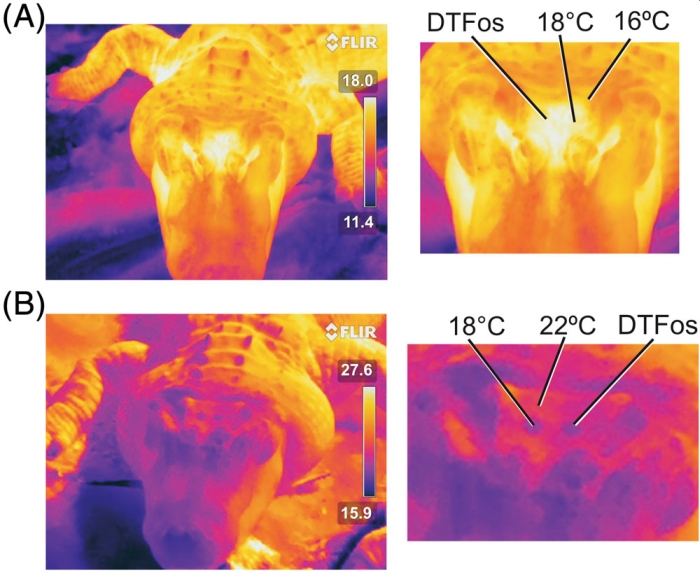 (Holliday et al., The Anatomical Legend, 2019)
It’s now not but identified whether or now not dinosaurs in neatly-liked, and T. rex in particular, were ectothermic or endothermic.
The topic is in actuality hotly debated, with some scientists pondering the extinct, some the latter, and a few believing dinosaurs fell somewhere between the two – a characteristic called mesothermy. Outdated research has urged that the armoured ankylosaur had “crazy straw” tunnels in its cranium to encourage befriend its brain at optimum temperatures.
Now this research means that T. rex (and assorted dinosaurs) expend one of the most thermoregulation ways of ectotherms, but what that in actuality methodology within the broader context of their metabolisms is but to be explored.
What the scientists can expose, in step with this research, is that there are no osteological substances on the cranium of the tyrannosaurus that teach the fenestra were sites of muscle attachment. They would presumably well moreover infer, in step with in trend alligators, that the fenestra would possibly moreover private been at threat of regulate temperature in the T. rex‘s cranium, by warming or cooling the blood that flows by device of blood vessels in the structures.
“We know that, in a similar trend to the T. rex, alligators private holes on the roof of their skulls, and so that they’re stuffed with blood vessels,” Witmer stated.
“But, for over 100 years now we private been striking muscle tissue exact into a same condominium with dinosaurs. By utilizing some anatomy and physiology of present animals, we can teach that we can overturn these early hypotheses referring to the anatomy of this section of the T. rex‘s cranium.”
The team’s research has been published in The Anatomical Legend.




Leave a comment
Sign in to post your comment or sign-up if you don't have any account.